Thursday, 17 November 2016

How Would you Like your Steak?

VOCABULARY: DEGREES OF DONENESS
 

On our last class we were dicussing about how to say when one can´t chew some kind of meat.
We usually say it is tough. Now , have a look at the picture above  to see  the different
degrees of doneness for meat (=punto de la carne).
 
 If you want to learn to cook the perfect steak, watch this video:


Sunday, 13 November 2016

Past Habit: Used to // Would // Past Simple

When we talk about things that happened in the past but don’t happen anymore we can do it in different ways.

Used to + infinitive / didn´t use to +infinitive / did you use to +infinitive?

  • We used to live in New York when I was a kid.
  • There didn’t use to be a petrol station there. When was it built?
  • What sports did you use to play when you were ten ?
We can use ‘used to’ to talk about past states ….
  • I used to go swimming every Thursday when I was at school.
  • I used to smoke but I gave up a few years ago.
… or we can use ‘used to’ to talk about repeated past actions

Remember that ‘used to’ is only for past states/actions that don’t happen now – we can’t use it for things that still happen now. Also, ‘used to + infinitive’ should not be confused with ‘be/get used to + ‘ing’ form’ – this is covered in a separate section.

Would
  • Every Saturday I would go on a long bike ride.
  • My teachers would always say “Sit down and shut up!”
We can use ‘would’ to talk about repeated past actions.

Often either ‘would’ or ‘used to’ is possible. Both of these sentences are possible.
  • Every Saturday, I would go on a long bike ride.
  • Every Saturday I used to go on a long bike ride.
However, only ‘used to’ is possible when we talk about past states.
  • We used to live in New York when I was a kid.
  • We would live in New York when I was a kid.
Past simple
  • We went/used to go/would go to the same beach every summer.
We can use the past simple in the same way as ‘used to’ and ‘would’ to talk about repeated past actions.
  • I had/used to have a dog called Charlie.
We can also use the past simple for past states.
  • I went to Egypt in 1988.
However, if something happened only once we can’t use ‘used to’ or ‘would’ – we must use the past simple.

To talk about present habits we use the Present Simple and an adverb of frequency (usually, always, often, never, etc.)
I usually study at the library. 
Now watch this video about Childhood and complete the exercises:
 

Monday, 17 October 2016

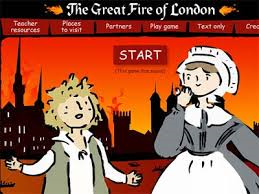
THE GREAT FIRE OF LONDON


Learn about this terrible event in the history of London and
PLAY A FUNNY GAME
at the end.
 
“Dad! Dad! Wake up! Something’s burning!”
 
       When Thomas Farriner, King Charles II’s baker, went to bed on the night of September 1, 1666, he forgot to put out the ovens.  Early the next morning, the wooden house caught fire, and by September 6, when they were finally extinguished, the flames had destroyed 80% of London.
Farriner’s maid was one of the surprisingly few (maybe only 6) people who died in the disaster, but the baker and his children escaped through a window. A month later, three members of the family were part of a jury that found a French watchmaker, Robert Hubert, guilty of deliberately starting the fire.  The poor man, whose confession was possibly made under torture, was not even in the country on September 2!
But, back to the bakery on Pudding Lane. Sparks jumped across the street and set fire to straw in the stables of the Star Inn, and the blaze really got out of control in nearby Thames Street, with its warehouses full of flammable materials (oil, coal, alcohol, candles).  Almost all the buildings in the city were made of wood – very dry after a long, hot summer – and a strong wind was blowing: the ingredients of a catastrophe.
This was the second catastrophe in the space of two years. In 1665 the Great Plague had killed around 100,000 people – or a quarter of London’s population. The king and his family had been criticised by some for escaping from the city during the epidemic, but now he stayed and organized the operation to fight the fire.  He ordered the firefighters to pull down buildings to create firebreaks, and was even seen with a bucket and spade, helping in the battle to save the capital.
   Eventually, the wind stopped blowing so hard and the fire, which had been visible          from 30   miles away, was out. By then it had destroyed 13,200 houses, 87 churches, many public buildings, and St Paul’s Cathedral. The famous architect Sir Christopher Wren was given the job of re-building London and his most famous creation is the great cathedral, completed in 1711. The new city was cleaner and safer, with wider streets and buildings made of brick or stone instead of wood.
The Monument to the Great Fire of London, built between 1671 and 1677, 62m high, stands 62m from the point where the fire started. Another small monument in Smithfield, central London, marks the place where it was stopped. And in 1986, in an official ceremony, the city’s bakers apologised to the Mayor for their colleague’s carelessness 320 years earlier.

 
NOW, PLAY THE GREAT FIRE OF LONDON GAME:
 
 
http://www.fireoflondon.org.uk/game/


Friday, 14 October 2016

Wednesday, 12 October 2016

ROALD DAHL 1º ESO

1.- LISTENING: ROALD DAHL´S LIFE 


 Audio file link: http://filecloud.io/sc439uoki    


2.- READING: ROALD DAHL´S LIFE


3.- READING: CHARLIE AND THE CHOCOLATE FACTORY


Monday, 10 October 2016

BASIC VERB PATTERNS: TO or -ING?


1) LIKES AND DISLIKES

    Like, hate, love, prefer, don't like, etc. > These verbs can take the:
          ~ Infinitive: for particular occasions
          ~ -ING : when talking in general

Ex:  I love being alone at home (in general)
        I love to be alone when I have to work.

Ex:  I like driving a lot but ...
       I don't like to drive during the rush hour.

# PREFER +  -ING  +   TO  +  -ING

Ex:  I prefer walking to cycling

# WOULD + these verbs + TO + INFINITIVE

Ex:   I would like to be a doctor one day.
        I would hate to spend Christmas alone.
        She would prefer to walk rather than drive.

#  ENJOY 
#  FANCY
#  WOULD / DON'T MIND          +  -ING
#  FEEL LIKE
#  CAN'T  STAND  
#  CAN' T RESIST
#  CAN´T HELP

 Ex:  Martha enjoys getting up very early on Saturdays
         Would you mind opening the window?
          I don' t mind doing the washing up.
          She can' t  stand trying on clothes.
          I can' t resist checking for text messages every few minutes.
          My sister can' t help biting her nails all the time.

BUT:  I can´t wait to see my best friend!

2) OTHER VERBS FOLLOWED BY -ING:
 
 -  detest, admit, look forward to, give up, suggest, involve, finish ...

EX., I´m looking forward to hearing from you.

        Sarah gave up smoking two years ago.

        We suggested going for a long walk.

*Negative form: Verb + NOT + -ING

Ex:  He admitted not paying for the ticket 

   - DO THE + -ING: mainly to talk about the housework
      Ex. Do the ironing/ shopping / hoovering / washing up...

   - GO + -ING: used for some sport activities.
      Ex: Go swimming / cycling / jogging / bungee jumping ...

3) VERBS FOLLOWED BY TO-INFINITIVE:
   Ex:      want        promise          wish            decide ...

                     agree       hope                refuse          offer ...

* Sometimes we can use an OBJECT between these verbs and the infinitive:

Ex: They want me to start work tomorrow.
      Sean asked the kids to help him with the preparations.


4) VERBS FOLLOWED BY INFINITIVE OR -ING WITH A CHANGE OF MEANING:

 Ex: Remember to do / doing
        Forget to do / doing
        Try to do / doing                                       (See next Blog entry)
        Stop to do sth / doing sth
        Regret to do / doing

* Be careful!  All the verbs WITH  PREPOSITION must be followed by -ING.
   
    Ex: He gave up smoking many years ago.
          We are thinking about buying a new car.


Now, for more explanation, watch this Video-tutorial on the use of Gerunds, 
to-infinitives and Bare infinitives.